
IC Interview: Courtney McClellan
By Paul Boshears

Photo from Courtney McClellan’s Instagram, 2022. Courtesy of the artist.
Paul Boshears
I first read about your work when Logan Lockner wrote about you for Art in America and that’s where I came across that fantastic phrase “applied fiction.” I was hoping we could have a conversation about that.
Courtney McClellan
That's the phrase that I use to describe what I think or I hope my work does no other term quite explained what I was hoping to address with my work. I have an adjacent relationship to creative nonfiction. It’s also a nod to parafiction. I interviewed the art historian Carrie Lambert-Beatty for Art Papers whose research addresses parafiction. Parafiction being a fiction that's parallel to actual history—although I think parafiction is an increasingly contentious space because of disinformation in society today.
There are many artists I really love who work in parafiction like Walid Raad, or my friends Priyanka Dasgupta and Chad Marshall (McClellan was curator for an exhibition of their works at UGA ). I define applied fiction as a means to test an existing system.
Another similar example is Jet Schouten’s “constructive journalism.” She created a fake medical device, and submitted it to a medical device approval board in the EU. This way of intervening as a journalist—making something and testing the medical device approval system. Her fictitious medical device was designed for women but the application stated that it killed one out of every three women who used it, and yet, it was approved. I see this as testing a system, or “applying” fiction.
I found that so fascinating, because again, I thought it was somebody making something that tested the system. I think that legal simulation—which is creative play—is a way to test the edges and boundaries of what the justice system does and does not do.
So for instance, in Mock Trial—which is what I've mostly followed—they don't define the race, gender, or ethnicity of any of the characters involved. And of course, these are very prejudicial aspects of the case. These are spaces where you can see how the game version tests the validity of the actual practice. This is a place where fiction and reality are pushing against each other constantly.
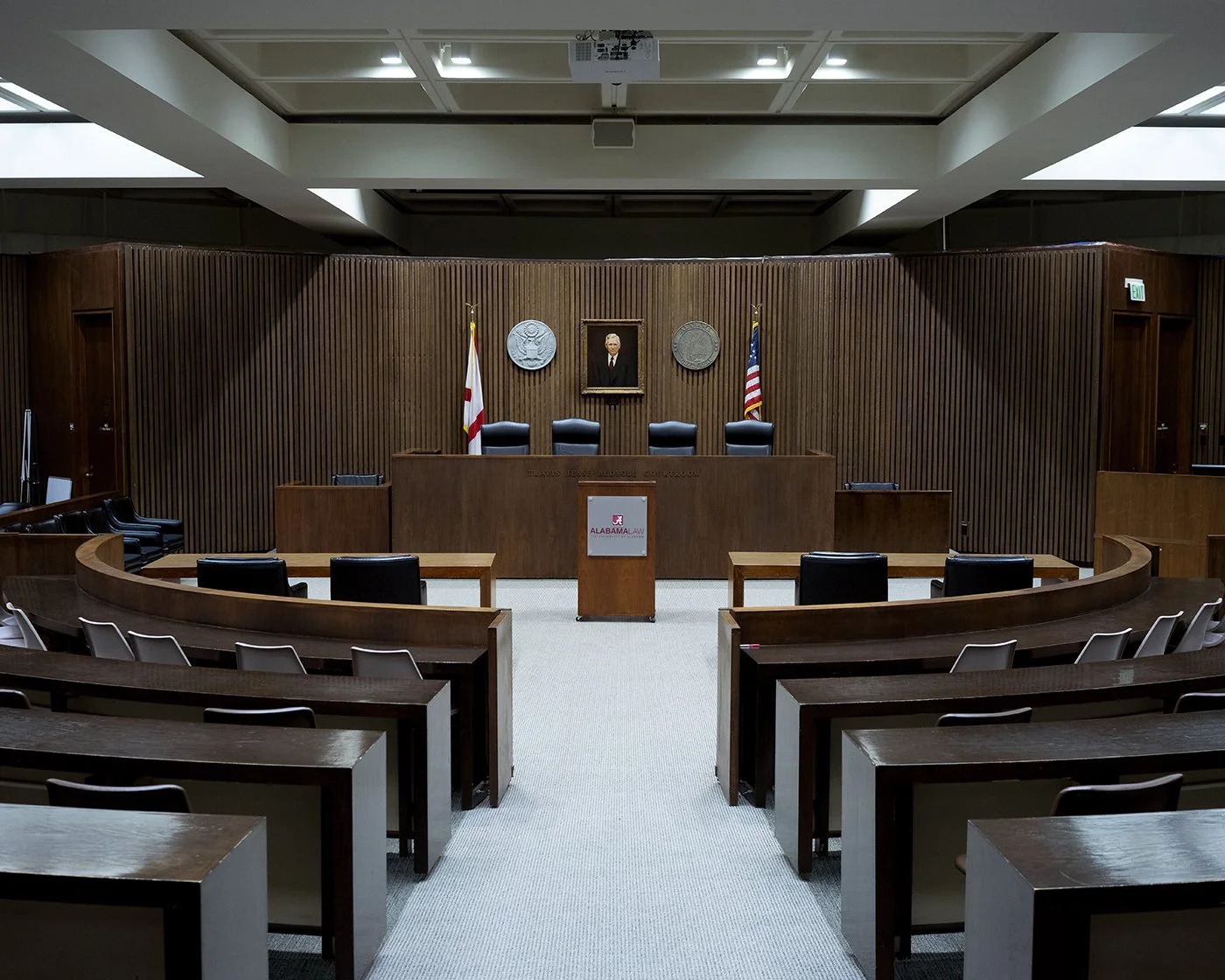
Courtney McClellan, Simulations (University of Alabama School of Law), 2020. Courtesy of the artist.
Paul Boshears
Oh, that's fantastic! Correct me if I'm oversimplifying it, it seems to me that the play version also shows how limited the real version is right?
Courtney McClellan
I think it's really a space of the ideal, right? A lot of the things that were most surprising about Mock Trial—and this is all in the beginning of the Midlands video that I made—is the way that the law is SUPPOSED to function, that race, and gender, and ethnicity don't matter, right? They point to that idealized version of the justice system, rather than the day-to-day practice of it. This, like, dream version, or clean version, as opposed to the messiness and humanity of people caught in the legal system.
Paul Boshears
I would imagine it reinforces this idyllic version of our society and our history.
Courtney McClellan
And then there's also the space where the students are testing-out things the way the students were engaging with the material. They were interested in sorting-out the complexity inside the case material. Mock Trial was fascinating to me. It was also a way—because the law is so incomprehensible, I'm not a lawyer—for me to try to comprehend this incomprehensible thing.

Courtney McClellan, Simulations (Cumberland School of Law at Samford University), 2020. Courtesy of the artist.
Paul Boshears
I'd love to hear about your relationship with Idea Capital, and the project you were thinking about doing.
Courtney McClellan
It is an organization I've known about for some time now. This is my second pass through Atlanta. The first time I came right out of undergrad and worked at the High in their education department. I remember thinking back then that Idea Capital was a very interesting premise. It was a way for artists and art lovers to support artists making projects with funding that was genuinely helpful.
For my Idea Capital project, I wanted to continue a long-term work, Simulations. For this project I photograph the courtrooms in law schools. It’s tied in with my overall practices involving performance, law, and education. I focus on courtrooms in the American South. I showed the first round of images at MOCA GA with their fellowship. At this point, I’ve photographed about 18 of approximately 50 Southern law schools. So there are many more to do. I've been working on that over this summer and I have been able to photograph three or four more schools. I feel so excited, you know, it has given me that jumpstart. I mean, gas is of course really expensive. Everything is more expensive now. So having guaranteed funding made my project feel really feasible. I also felt supported—that the Atlanta community backed my project.
Paul Boshears
That's so great. I really appreciate that you've put so much into inducing that sense of wonder into these potentially really boring, or scary—maybe only scary—places that are overtly punitive places.

Courtney McClellan, Simulations (University of North Carolina at Chapel Hill School of Law), 2020. Courtesy of the Artist.
Courtney McClellan
I think what I'm ultimately studying or asking is this, “what are moments or places that things could change?” Maybe—if the lawyers are trained differently—what might happen? We are living with our first few generations of Mock Trial trained lawyers. Moments of newness are curious to me.
Paul Boshears
You have this title, Simulations, right? You keep gesturing towards these people who are doing make believe. It isn't true. Do you feel an obligation as an artist—or that other artists ought to have some obligation—towards what is true or what is real?
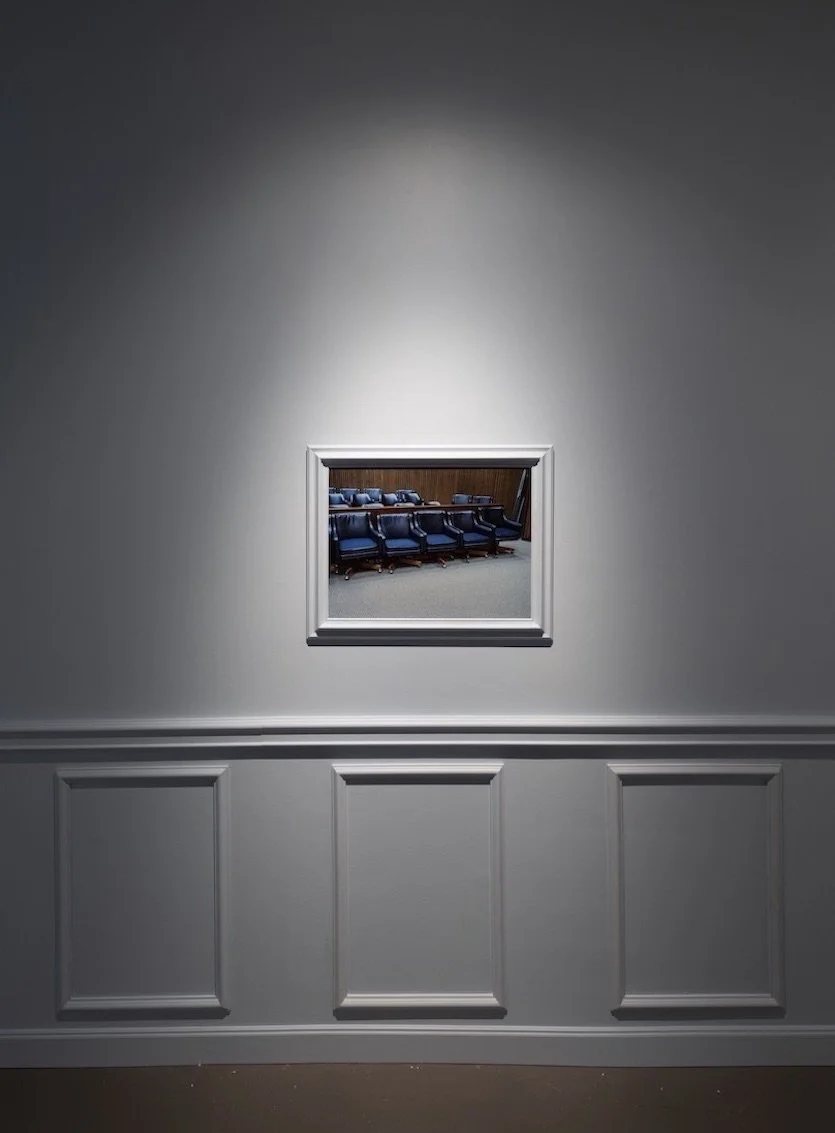
Installation view of Courtney McClellan’s Simulations (University of Alabama School of Law (Jury Chairs), 2020. at the Museum of Contemporary Art of Georgia, photo by Fredrik Brauer.
Courtney McClellan
Well, I think I would say it is true, and it isn't right. I think the reality of what's fascinating to me about Mock Trial or legal simulation is most of these are people pretending to be their future selves. So it is not that they're pretending or playingalong. There are characters in Mock Trial and people playing characters as witnesses, but many of them are playing, you know, District Court judges and they want to be a District Court judge.
I don't think it's quite that stark contrast of reality and full-on make believe. This is why I am interested in performance. There's even that weird space as in method acting: in the moment you believe that you are who you are the character. I am interested in the overlap between contemporary performance and the performance of everyday life.
As for truth: in my optimistic moments, I think artists can help us deal with complexity. And I think that's the kind of cultural thing that we're often missing right? That ability to hold two contradictory ideas in our mind simultaneously. Art can help us connect the dots of seemingly disparate things that can all be true, or be complicated or feel untrue all in the same moment, and yet they coexist. I'm not tied to artists having to share only fact-based research. I still really believe in fiction. Fiction can help us feel things that we wouldn't otherwise.I studied journalism, so I often engage in traditional forms or research, but also know artistic, emotional, intellectual truths can be performed in unexpected ways. But ultimately, I became an artist not a journalist, I took a different path to truth hunting.
Paul Boshears
That's awesome. Thanks so much, Courtney. This has been so fantastic.
Please join us in raising funds to support artists like Courtney McClellan. All contributions go 100% to Atlanta artist grants. Please become an Idea Capital investor.